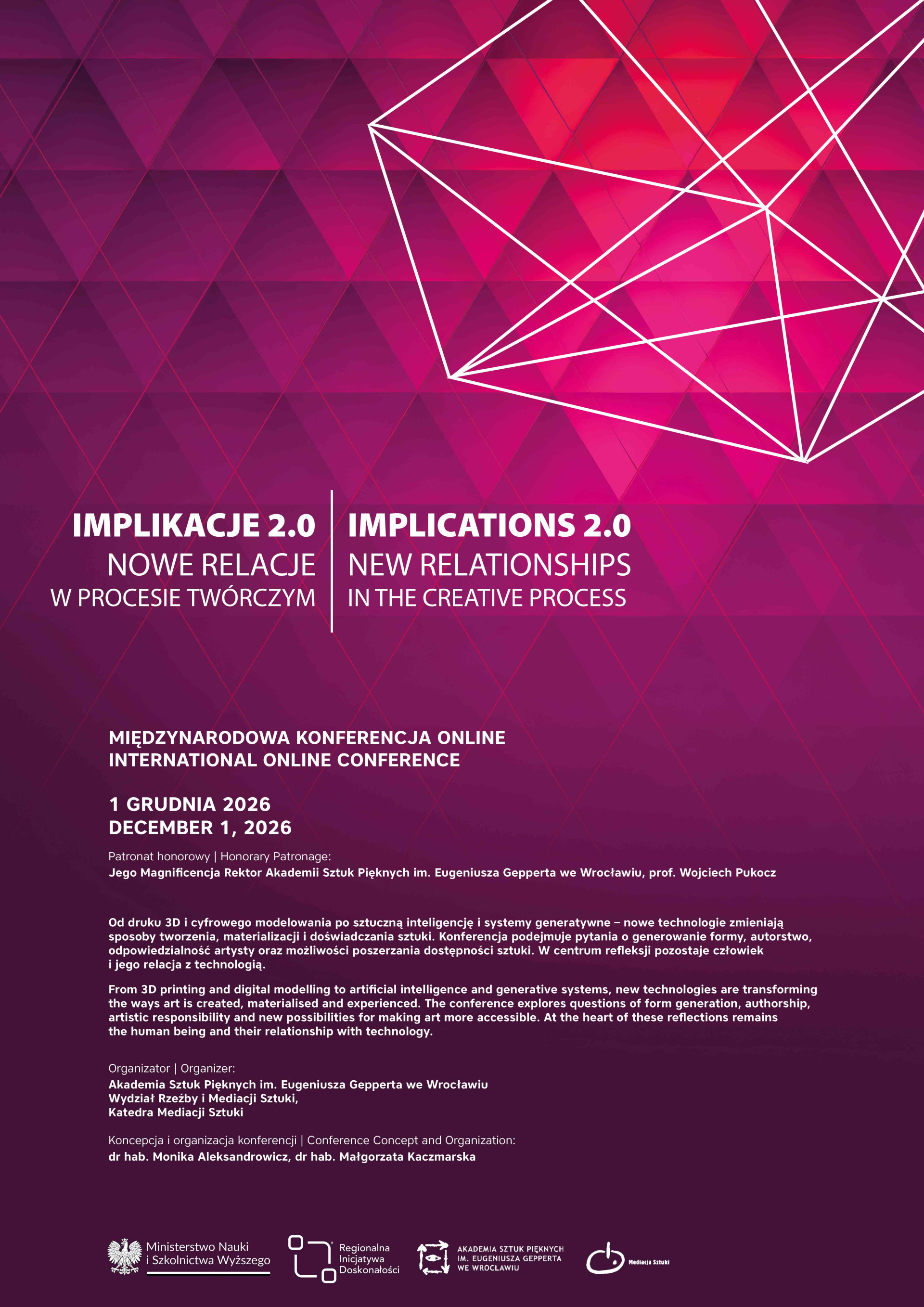
IMPLICATIONS 2.0. NEW RELATIONSHIPS IN THE CREATIVE PROCESS

Microsoft Teams, online conference
Honorary Patronage:
His Magnificence Prof. Wojciech Pukocz, Rector of the Eugeniusz Geppert Academy of Art and Design in Wrocław, Poland
Organizer:
The Eugeniusz Geppert Academy of Art and Design in Wrocław
Faculty of Sculpture and Art Mediation
Department of Art Mediation
Conference Concept and Organization:
Monika Aleksandrowicz, PhD, DSc
Małgorzata Kaczmarska, PhD, DSc
Rada Naukowa Konferencji | Scientific Committee
prof. Jakub Jernajczyk – Akademia Sztuk Pięknych im. Eugeniusza Gepperta we Wrocławiu, Polska
Eugeniusz Geppert Academy of Art and Design in Wrocław, Poland
prof. Rosângela da Silva Leote – Universidade Estadual Paulista (UNESP), São Paulo, Brazylia
São Paulo State University (UNESP), Brazil
prof. dr hab. Maciej Manikowski – Uniwersytet Wrocławski, Polska; University of Wrocław, Poland
dr hab. inż. arch. Antonino Margagliotta – Università degli Studi di Palermo, Włochy; University of Palermo, Italy
dr hab. Grzegorz Niemyjski, prof. ASP – Akademia Sztuk Pięknych im. Eugeniusza Gepperta we Wrocławiu, Polska
Eugeniusz Geppert Academy of Art and Design in Wrocław, Poland
prof. Aleksander Józef Olszewski – Uniwersytet Radomski im. Kazimierza Pułaskiego, Polska
Casimir Pulaski Radom University, Poland
dr hab. Marta Płonka, prof. ASP – Akademia Sztuk Pięknych im. Eugeniusza Gepperta we Wrocławiu, Polska
Eugeniusz Geppert Academy of Art and Design in Wrocław, Poland
prof. Jan Tutaj – Akademia Sztuk Pięknych im. Jana Matejki w Krakowie, Polska
Jan Matejko Academy of Fine Arts in Kraków, Poland
dr hab. Àngels Viladomiu – Universitat de Barcelona, Hiszpania; University of Barcelona, Spain
About the Conference
From 3D printing and digital modelling to artificial intelligence and generative systems, new technologies are transforming the ways art is created, materialised and experienced.
IMPLICATIONS 2.0. NEW RELATIONSHIPS IN THE CREATIVE PROCESS continues a project dedicated to the presence of technology in contemporary artistic practices. This edition focuses not so much on the tools themselves as on the consequences of their use: transformations of the creative process, changing understandings of authorship, artistic responsibility, and relationships between human beings, technology and artworks.
The conference programme encompasses five thematic areas: From Idea to Form; The Artist and Artificial Intelligence; Matter and Technology; Boundaries of Authorship and Interpretation; Art, Perception and Participation.
Bringing together artistic, academic and educational perspectives from different countries, the conference provides a space for exchanging experiences and critically reflecting on the possibilities and limitations of contemporary technologies.
The conference marks the first stage of a project that will continue with an international exhibition planned for 2027.
Contact:
m.aleksandrowicz@asp.wroc.pl
m.kaczmarska@asp.wroc.pl
IMPLICATIONS 2.0. NEW RELATIONSHIPS IN THE CREATIVE PROCESS
A Critical Perspective
IMPLICATIONS 2.0. NEW RELATIONSHIPS IN THE CREATIVE PROCESS is the next edition of a project dedicated to the presence of new technologies in artistic practices and the changes they bring about in the ways art is created, conceptualised and experienced.
IMPLICATIONS 2.0 seeks to examine technology through the consequences of its presence in art. Our interest lies not so much in the novelty of successive tools as in what happens to the creative process when we begin to use them. We want to consider how the role of the artist is changing, how contemporary artistic form emerges, and whether technology can contribute to more conscious and accessible participation in art. At the heart of these considerations remains the question of the human being who uses technology, makes decisions and gives meaning to what is created through it.
The first edition of the project focused primarily on 3D printing as a tool opening up new possibilities for artistic creation. At that time, our attention was directed towards the relationship between the digital model and the physical object, technological experimentation, and the ways in which new tools become part of the artist’s practice. Even then, however, questions emerged concerning authorship, the authenticity of the artwork, ecology, responsibility, and the status of a work that can exist both as a digital record and as a materialised form. These reflections were further developed in the monograph 3D. Implications. Digit and Form (3D. Implikacje. Cyfra I bryła). The texts collected in the publication demonstrated that technology is not merely a neutral means of production. It influences how ideas are formulated, how the creative process unfolds, and how the artwork itself is understood. At the same time, art emerged as a space of mediation between experimentation, knowledge, technology and social experience.
Today, we return to these questions in circumstances that have changed far more rapidly than could have been anticipated just a few years ago. The development of artificial intelligence and generative systems has meant that technology is increasingly involved not only in the production of artworks but also in their conception and design.
It can suggest solutions, transform data, generate variations and influence decisions made by the artist.
In this new situation, simply asking what technology is capable of seems insufficient. We are primarily interested in how the presence of new technologies transforms the creative process. How does it influence decision-making? What happens to authorship when part of the process is entrusted to a generative system? Does the artist still design a specific form, or do they increasingly establish the conditions under which a form may emerge? Where does the tool end, and where does technology’s participation in the creative process begin?
For this reason, a critical perspective will be a central point of reference for the conference. We are interested neither in unconditional enthusiasm for new technologies nor in their outright rejection. Instead, we want to examine what they actually change, what they make possible, and what limitations and new dependencies they introduce. Today, the development of technological tools requires not only increasingly advanced skills but also a growing awareness of the consequences of their use. Technological transformations are also taking place within the broader context of changing working conditions for artists. Mobility, the costs of maintaining studios and storing artworks, and access to infrastructure all influence how artistic practice is organised. Although the digital environment may offer greater freedom of action, it also creates new dependencies on hardware, software and digital platforms.
One of the conference’s key areas will be GENERATING FORM. The contemporary creative process may begin with text, an image, data, a scan, code or the operation of an algorithm, and only subsequently lead to a spatial model and its materialisation. 3D printing remains an important part of this process, but it becomes one stage within a much more complex sequence of activities. Our aim is therefore not only to present new methods of creation but also to reflect on how form emerges and who ultimately determines its final shape. The ease with which successive variations can be generated also prompts us to reconsider the questions of production and overproduction in art. The possibility of reducing physical materialisation does not automatically mean reducing production itself, which may instead shift into the digital environment.
A second important area will be THE ROLE OF THE ARTIST. Changing technologies require new skills, but they also encourage us to reconsider the competencies we regard as fundamental to artistic practice. The conscious selection of tools, the ability to work with generative systems, and the critical evaluation of their outcomes are becoming increasingly important. Alongside these developments come questions of responsibility, copyright and ethics. These issues also concern art education, which must respond to changing working conditions without losing sight of individual decision-making, critical reflection and creative responsibility.
We also wish to devote particular attention to TECHNOLOGY AS A MEANS OF ACCESS TO ART. In this area, new technological solutions may have significance extending far beyond the process of producing an artwork. 3D printing and scanning, digital reconstructions, tactile models, multisensory approaches and the possibilities offered by artificial intelligence can support engagement with art for people for whom traditional methods of presentation may be insufficient or inaccessible. We want to approach this issue from the perspective of audiences with diverse perceptual and cognitive abilities. However, the question is not only what technology can offer them. Equally important is whether every technological solution genuinely increases accessibility. A new tool may open up opportunities, but it may also create further barriers.
It is at this point that art mediation becomes particularly significant. We do not wish to understand mediation solely as an activity undertaken once an artwork has been completed and the conditions for an encounter with its audience need to be established. Mediation can be present much earlier in the process. It can influence how a work is conceived, which tools are selected, and how decisions are made about the ways in which the work can be experienced. Understood in this way, mediation allows us to consider technology not merely as a means of producing new forms, but also as an element in building relationships between art and human experience.
The online conference, scheduled for 1 December 2026, will constitute the first stage of the project. However, we do not want the reflection initiated during the conference to end with its final panel. It will be further developed through an international exhibition planned for the following year, bringing together artists whose practices engage with the issues addressed by the conference. From the outset, the exhibition has been conceived as a continuation of research into new technologies and contemporary artistic practices. It will provide an opportunity to bring the discussion into the realm of concrete artistic realisations. The questions raised during the conference will be explored through artworks, creative processes, material experiments and different strategies for working with technology. We therefore do not regard the exhibition as an illustration of the conference, but as a further stage of inquiry, in which the questions previously formulated will be confronted with artistic practice.
Monika Aleksandrowicz , PhD, DSc.
Concept, intellectual framework, and final editing: Monika Aleksandrowicz, PhD, DSc. and Małgorzata Kaczmarska, PhD, DSc.
ChatGPT (OpenAI) was used in the preparation of this text as a tool to support linguistic editing, content organisation, and translation into English.